
Industry:Banking and Finance Added By:Admin Posted On:Nov. 27, 2026
Key points
A BSA AML program is the written compliance program the Bank Secrecy Act (BSA) requires of banks, credit unions and other covered financial institutions to guard against money laundering and terrorist financing. It rests on four pillars set by statute (internal controls, independent testing, a designated BSA officer and training) plus customer due diligence, which FinCEN’s 2026 rulemakings describe as the “fifth pillar.” As of November 2026 those rules have not changed: FinCEN’s April 2026 proposal to rewrite them, and the matching banking agency proposals, are still awaiting final rules.
The four statutory pillars come from 31 U.S.C. 5318(h)(1): each financial institution must establish an anti-money laundering and countering the financing of terrorism (AML/CFT) program that includes, at a minimum, internal policies, procedures and controls; a designated compliance officer; an ongoing employee training program; and an independent audit function to test the program. FinCEN’s 2016 Customer Due Diligence (CDD) Rule added risk-based ongoing customer due diligence to the program rules for banks and certain other institutions.
For banks, FinCEN’s program rule, 31 CFR 1020.210, lists all five. Each federal banking agency has a parallel rule with the first four pillars. The table shows where each pillar sits today, what examiners check under the Federal Financial Institutions Examination Council (FFIEC) BSA/AML Examination Manual, and what the April 2026 proposal would change if it is finalized as written.
| Pillar | Current rule for banks | What examiners look for (FFIEC manual) | What the April 2026 proposal would change |
|---|---|---|---|
| 1. Internal controls | 31 CFR 1020.210(a)(2)(i); 12 CFR 21.21(d)(1), 208.63(c)(1), 326.8(c)(1), 748.2(c)(1) | Controls that reflect the bank’s risk assessment, segregation of duties, timely updates for new rules, and reports to the board on deficiencies and SAR filings | A “risk-based set of internal policies, procedures, and controls” that must include documented risk assessment processes and direct more resources to higher-risk customers and activities |
| 2. Independent testing | 1020.210(a)(2)(ii): by bank personnel or an outside party | Tester independence, risk-based scope, results reported to the board or a board committee, frequency suited to the risk profile | Kept; testing should use objective criteria, and testers should not substitute their own judgment for the institution’s |
| 3. BSA officer | 1020.210(a)(2)(iii): an individual or individuals coordinating and monitoring day-to-day compliance | Qualifications, authority, independence, resources and regular reporting to the board | Officer must be located in the United States and is responsible for establishing and implementing the program |
| 4. Training | 1020.210(a)(2)(iv): training for appropriate personnel | Role-based content, board training and records of who was trained and when | Wording becomes the statute’s “ongoing employee training program”; FinCEN calls this clarifying, not substantive |
| 5. Customer due diligence | 1020.210(a)(2)(v) and 31 CFR 1010.230 (beneficial owners) | Customer risk profiles, ongoing monitoring and beneficial ownership procedures | Moves under the internal controls pillar with no intended change in substance |
Internal controls are the bank’s policies, procedures and processes for meeting every BSA requirement that applies to it. The core reporting and recordkeeping duties for banks include:
Banks must understand the nature and purpose of each customer relationship to build a customer risk profile, and monitor on an ongoing basis to report suspicious activity and, on a risk basis, keep customer information current. For legal entity customers, 31 CFR 1010.230 requires identifying and verifying each individual who owns 25 percent or more of the equity interests and one individual with significant responsibility to control the entity, unless the customer or account falls under one of the rule’s exclusions or exemptions.
Two 2026 changes affect this pillar. FinCEN’s exceptive relief order FIN-2026-R001 (February 13, 2026) lets covered institutions identify and verify beneficial owners when a legal entity customer first opens an account, again when facts call the information into question, and as their risk-based CDD procedures require, rather than at every new account. A separate CDD proposal published November 19, 2026 would write that relief into the rule, list the beneficial owner information to collect in the rule text, limit use of an Individual Taxpayer Identification Number (ITIN) for that collection, and make explicit that institutions may ask for more information where risk warrants it, including immigration status and work authorization when relevant. Comments are due January 19, 2027.
Eleven types of financial institutions are covered by FinCEN AML program rules today: banks, casinos and card clubs, money services businesses, broker-dealers, mutual funds, insurance companies, futures commission merchants and introducing brokers, dealers in precious metals, stones or jewels, operators of credit card systems, loan or finance companies, and housing government-sponsored enterprises (31 CFR 1020.210 through 1030.210). Registered investment advisers were added by a 2024 rule whose effective date has been delayed to January 1, 2028. Each type has its own rule; this guide covers banks and credit unions.
A bank with a federal functional regulator meets FinCEN’s rule partly by complying with its regulator’s program rule, and each of those rules requires a written program approved by the board of directors.
| Institution | Program rule | Approval requirement today |
|---|---|---|
| National banks and federal savings associations (OCC) | 12 CFR 21.21 | Written, approved by the board, reflected in the minutes |
| State member banks (Federal Reserve) | 12 CFR 208.63 | In writing, approved by the board, noted in the minutes |
| FDIC-supervised institutions (as defined in 12 CFR 326.1) | 12 CFR 326.8 | Written, approved by the board, noted in the minutes |
| Federally insured credit unions (NCUA) | 12 CFR 748.2 | Written, approved by the board, reflected in the minutes |
| Banks without a federal functional regulator (for example private banks, non-federally insured credit unions, certain trust companies) | 31 CFR 1020.210(b) | Written, approved by the board or, if there is no board, an equivalent governing body; a copy to FinCEN on request |
Approval is the start of board oversight, not the whole of it. The FFIEC manual says the board is ultimately responsible for BSA compliance, must make sure the BSA officer has enough authority, independence and resources, and that appointing a BSA officer is not by itself enough to meet the program requirement.
The rules require “designation of an individual or individuals responsible for coordinating and monitoring day-to-day compliance” (the NCUA rule says “an individual”). The FFIEC manual adds that the board must designate a qualified person, that the title does not matter, and that the officer’s authority, independence and access to resources are what examiners weigh.
Under the 2026 proposal the officer, renamed the AML/CFT officer, would have to be located in the United States and be accessible to FinCEN and the bank’s regulator, as the AML Act already requires of the persons responsible for the program. Staff outside the United States could still perform some AML/CFT functions. FinCEN’s preamble also says the officer should be qualified and not overburdened with other responsibilities.
No regulation sets a frequency. The rules require only “independent testing for compliance to be conducted by bank personnel or by an outside party.” The FFIEC manual states that there is no regulatory requirement for independent testing frequency and that testing should be commensurate with the bank’s risk profile. A bank may test at periodic intervals, for example every 12 to 18 months, and when its risk profile, systems, compliance staff or processes change significantly, and more often when errors or deficiencies have been found.
Testing can be done by internal audit, outside auditors or consultants, or, at banks without those, qualified bank staff who are not involved in the function being tested. An outside firm should not also do other BSA work at the bank that could compromise its independence, such as training or writing policies. Whoever tests should report directly to the board or to a board committee made up primarily or completely of outside directors (FFIEC manual, independent testing). Smaller, lower-risk banks may share a testing resource with other banks.
The FFIEC manual lists what a risk-based test may review: whether the risk assessment matches the bank’s products, services, customers and locations; whether policies follow that risk profile and staff follow the policies; CIP, CDD, beneficial ownership, SAR, CTR and exemption compliance; the SAR decision process; the accuracy of the systems behind monitoring and reports; training records; and whether earlier findings were fixed. The report should give a conclusion on overall BSA compliance or enough information to reach one.
The 2026 proposal keeps the pillar. FinCEN’s preamble says the AML/CFT officer, or anyone reporting to that officer, would generally not be independent enough to do the testing, and that outside testers should not be involved in functions such as AML/CFT training or writing the policies they test.
The rules require “training for appropriate personnel” and set no frequency. The FFIEC manual expects training to cover the BSA requirements relevant to the bank, supervisory guidance and the bank’s own procedures, tailored to each person’s duties, and documented so auditors and examiners can review it. BSA/AML is one item on the wider list of required training for bank employees, which also covers topics outside the BSA.
| Audience | What the FFIEC manual expects | Evidence to keep |
|---|---|---|
| New employees | An overview of the BSA’s purposes and requirements at orientation or reasonably soon after | Completion date for each new hire |
| Front-line staff, such as tellers | Examples tailored to their area, such as large currency transactions and suspicious activity | Materials, dates, attendance |
| Lending, trust, private banking and correspondent banking staff | Targeted training on the risks of their business line | Materials, dates, attendance |
| BSA officer and BSA staff | Periodic training on regulatory changes and changes in the bank’s risk profile | Courses taken, dates |
| Board and senior management | Foundational training and updates on new BSA developments, enough to oversee the program | Board minutes or attendance records |
| Agents performing BSA functions | Training for agents responsible for BSA-related functions on the bank’s behalf | Records from the agent or third-party trainer |
Keep the training and testing materials, session dates, attendance, and any failures to complete training on time with the corrective action taken. An annual schedule is a choice the bank can make, not a legal rule. FinCEN’s preamble to the 2026 proposal says the frequency and content of training depend on the institution’s risk profile and each person’s role, and that institutions may decide which employees and non-employees need ongoing training.
Not under today’s bank rules. The FFIEC manual calls a well-developed BSA/AML risk assessment “not a specific legal requirement,” but it is where examiners start: they review it during exam scoping to understand the bank’s money laundering and terrorist financing risks. The FFIEC describes two steps: identify the risk categories (products, services, customers and geographic locations), then analyze the data in each, such as the number and dollar amount of funds transfers. Putting it in writing is described as sound practice.
The 2026 proposal would not add a separate pillar. It would make risk assessment processes an explicit part of the internal controls pillar. Under proposed 1020.210(b)(1)(i), the processes would have to:
FinCEN published the first government-wide AML/CFT Priorities on June 30, 2021. In no particular order: corruption; cybercrime, including cybersecurity and virtual currency considerations; foreign and domestic terrorist financing; fraud; transnational criminal organization activity; drug trafficking organization activity; human trafficking and human smuggling; and proliferation financing. The statute requires an update at least every four years, but the April 2026 proposal still cites the 2021 list. FinCEN’s fact sheet says institutions will not have to incorporate the priorities into their programs until a final rule takes effect.
Fraud is one of the eight. For ACH payments it also carries separate private-rule duties: the Nacha fraud monitoring rules took effect in two phases in 2026.
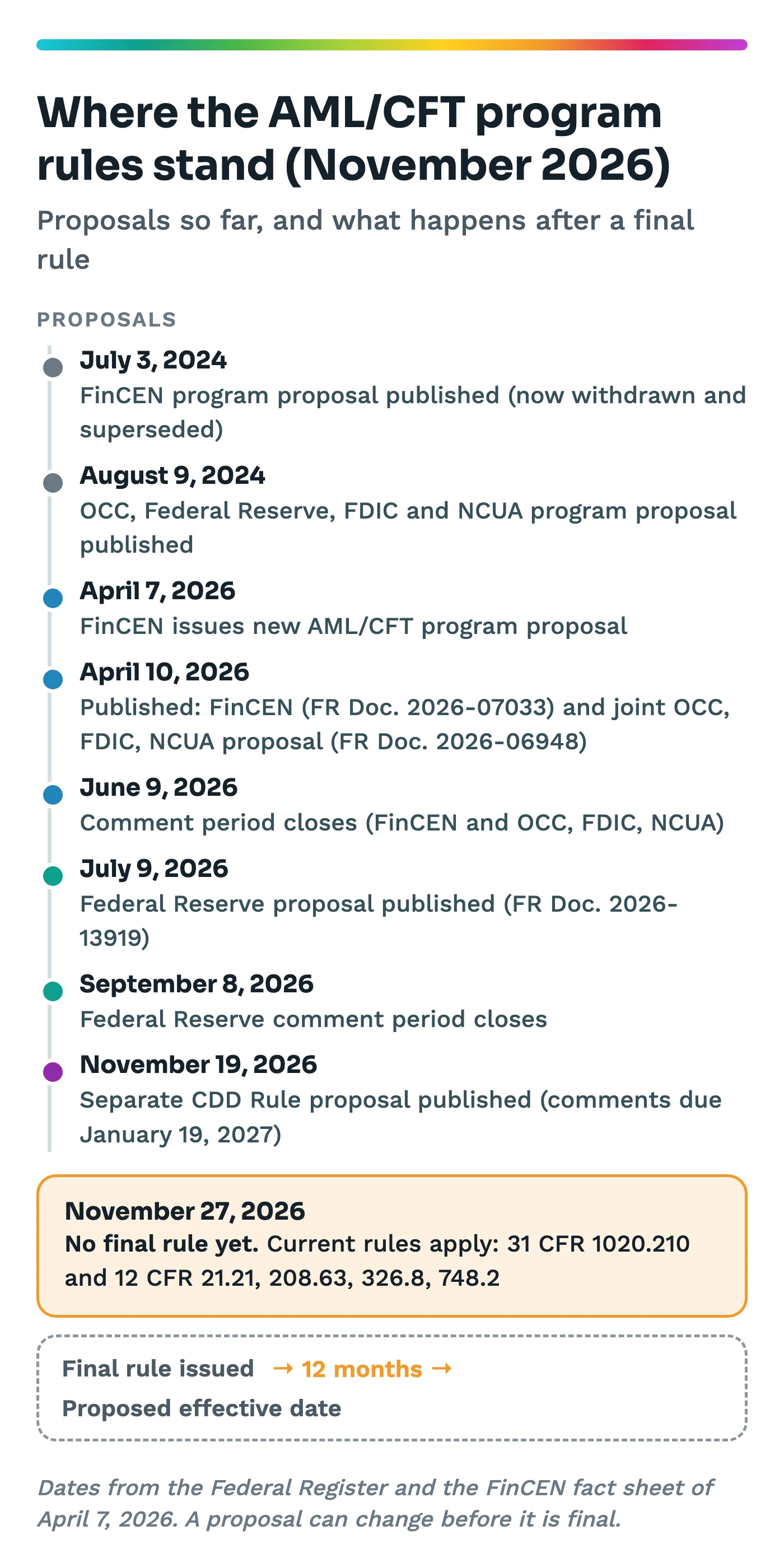
FinCEN issued the proposal on April 7, 2026, and the Federal Register published it on April 10 (FR Doc. 2026-07033, docket FINCEN-2026-0034). It covers all eleven types of financial institutions with FinCEN program rules. The OCC, FDIC and NCUA proposed matching changes to their own rules the same day (FR Doc. 2026-06948), and the Federal Reserve followed on July 9, 2026 (FR Doc. 2026-13919).
| Date | Step |
|---|---|
| July 3, 2024 | FinCEN’s earlier program proposal published (the banking agencies followed on August 9, 2024); the 2026 FinCEN proposal says the 2024 FinCEN proposal is withdrawn and superseded |
| April 10, 2026 | FinCEN proposal and the joint OCC, FDIC and NCUA proposal published |
| June 9, 2026 | Comment period closed for both |
| July 9, 2026 | Federal Reserve proposal published; comments closed September 8, 2026 |
| November 19, 2026 | Separate CDD Rule proposal published; comments due January 19, 2027 |
| As of November 27, 2026 | No final rule published by FinCEN or any banking agency |
| Final rule (no date set) | Proposed effective date: 12 months after the final rule is issued |
An AML/CFT program would be “effective” if the institution establishes it as the rule requires and maintains it by implementing it “in all material respects.” Keeping the program current as the risk profile changes would count as part of establishing it. For banks, once a program is properly established, FinCEN says implementation problems would warrant an enforcement action or a significant supervisory action only if they are significant or systemic failures, not isolated, technical or immaterial issues.
Until final rules take effect, banks are examined against the current 31 CFR 1020.210 and their regulator’s rule. A proposal can change before it is finalized, so treat the details above as proposed text, not requirements.
Use this list to check each pillar against today’s rules and to prepare for a final rule without acting on proposed text too early.
Internal policies, procedures and controls; independent testing; a designated BSA compliance officer; training for appropriate personnel; and risk-based ongoing customer due diligence. The first four are minimum elements in 31 U.S.C. 5318(h)(1) and the banking agencies’ rules; the fifth was added to FinCEN’s program rules for banks and certain other institutions by the 2016 CDD Rule and appears in 31 CFR 1020.210(a)(2)(v).
Not under current bank rules. The FFIEC BSA/AML Examination Manual calls a well-developed risk assessment “not a specific legal requirement,” although examiners review it during exam scoping and planning. FinCEN’s April 2026 proposal would require risk assessment processes as part of the internal controls pillar rather than as a separate pillar, but as of November 2026 that proposal is not final.
For national banks, federal savings associations, state member banks, FDIC-supervised institutions and federally insured credit unions, the board of directors must approve the written program and the approval must be noted or reflected in the minutes (12 CFR 21.21, 208.63, 326.8 and 748.2). A bank without a federal functional regulator needs approval by its board or, if it has no board, an equivalent governing body (31 CFR 1020.210(b)). The 2026 proposals would also allow approval by appropriate senior management, but they are not final.
No regulation sets a frequency: the rules require “training for appropriate personnel.” The FFIEC manual expects an overview for new staff at orientation or reasonably soon after, periodic training for the BSA officer and BSA staff, foundational training and updates for the board, and documentation of who was trained and when. An annual cycle is an internal choice, not a legal requirement.
No regulation sets a frequency. The FFIEC manual says testing should be commensurate with the bank’s risk profile, gives periodic intervals such as every 12 to 18 months and testing after significant changes as examples, and suggests more frequent testing when deficiencies have been found. The tester must be independent of the BSA function and should report to the board or a board committee made up primarily or completely of outside directors.
No. As of November 27, 2026, FinCEN’s proposal (published April 10, 2026, FR Doc. 2026-07033) and the matching OCC, FDIC and NCUA proposal (April 10) and Federal Reserve proposal (July 9) have not been finalized. Their comment periods closed June 9 and September 8, 2026, and each proposes an effective date 12 months after a final rule is issued, so banks are examined under the current rules until then.
Get regulation updates and new banking webinars
The weekly 247Compliance email lists new live sessions and regulation updates. Unsubscribe any time.
SubscribeThis article is general information, not legal or tax advice. Check the official sources above or consult a qualified advisor for your situation.