
Industry:Banking and Finance Added By:Admin Posted On:Nov. 24, 2026
Key points
ACH return codes are the reason codes, R01 to R85, that a receiving bank (the RDFI) attaches when it sends an ACH entry back to the originating bank (the ODFI). Most returns must reach the ODFI within 2 banking days of the Settlement Date. Unauthorized consumer debits returned with R05, R07, R10 or R11 get an extended window of 60 calendar days. The chart below pairs every code with its deadline, then covers R01 to R04 and R29, return rate thresholds, dishonored returns and the Nacha rule changes that affect returns, as of November 2026.
An ACH return code tells the Originator why an entry was sent back instead of posting. The codes are defined in Appendix Four of the Nacha Operating Rules. The rulebook is sold, not published free, so the titles here are paraphrased and checked against Nacha’s public rule summaries, Federal Reserve and Treasury publications, and a Nacha-member payments association’s chart, with bank charts used for some of the rarer codes. For edge cases, confirm against the current Rules with your ODFI or RDFI. Return handling is also among the Nacha audit requirements checked in the annual Rules Compliance Audit, which is due by December 31.
If a return is late or wrong, the ODFI can send it back as a dishonored return, and the RDFI can answer with a contested dishonored return. Both are covered below.
About 70 codes are in use, numbered from R01 to R85 with gaps (there is no R48, R49 or R54 to R60, for example). One more is on the way: Nacha has adopted R90 for returns made to meet an RDFI’s sanctions compliance obligations, effective March 17, 2028.
Not every problem produces a return. When an entry can post but carries outdated account details, the RDFI sends a Notification of Change with a C code instead. The six change codes that federal agencies process, according to Treasury’s Green Book, are C01 (incorrect account number), C02 (incorrect routing number), C03 (incorrect routing and account number), C05 (incorrect transaction code, such as checking instead of savings), C06 (incorrect account number and transaction code) and C07 (incorrect routing number, account number and transaction code). The Originator must make the change within six banking days of receiving the NOC information or before its next entry to that account, whichever is later, with limited exceptions. Nacha’s Supporting Documentation Quick Reference (2026) lists entries sent six or more banking days after an NOC as a reportable violation of Rule 2.12.1.
How to read the deadline column. “2 banking days” means the return must be available to the ODFI by the opening of business on the second banking day after the Settlement Date of the original entry. “60 calendar days” is an extended return: it must reach the ODFI by the opening of business on the banking day after the 60th calendar day following the Settlement Date, and most of these need a signed Written Statement of Unauthorized Debit (WSUD) from the consumer.
| Code | Meaning (paraphrased) | Return deadline | Note for the Originator |
|---|---|---|---|
| R01 | Insufficient funds | 2 banking days | May be reinitiated up to two more times |
| R02 | Account closed | 2 banking days | Administrative return; get new account details |
| R03 | No account or unable to locate account | 2 banking days | Administrative return; confirm the account number |
| R04 | Invalid account number structure | 2 banking days | Administrative return; usually a typo or wrong length |
| R05 | Unauthorized debit to a consumer account using a corporate SEC code (CCD or CTX) | 60 calendar days, WSUD | Counts as unauthorized |
| R06 | Returned at the ODFI’s request | No fixed deadline | RDFI may agree; the ODFI indemnifies the RDFI |
| R07 | Authorization revoked by customer | 60 calendar days, WSUD | Counts as unauthorized; stop future debits |
| R08 | Payment stopped | 2 banking days | Resend only with the Receiver’s new authorization |
| R09 | Uncollected funds | 2 banking days | Same reinitiation limit as R01 |
| R10 | Customer advises Originator is not known or not authorized to debit the account | 60 calendar days, WSUD | Counts as unauthorized; consumer accounts and IAT debits |
| R11 | Customer advises entry not in accordance with the terms of the authorization | 60 calendar days, WSUD | Counts as unauthorized; a fixable error can be corrected and resent |
| R12 | Account sold to another financial institution | 2 banking days | Get new account details |
| R13 | Invalid ACH routing number (older systems label it “RDFI not qualified to participate”) | Usually returned by the ACH Operator | Check the routing number |
| R14 | Representative payee deceased or unable to continue in that capacity | 2 banking days | Do not reinitiate |
| R15 | Beneficiary or account holder (other than a representative payee) deceased | 2 banking days | Do not reinitiate |
| R16 | Account frozen, or entry returned per OFAC instruction | 2 banking days | Do not reinitiate; retitled “Account Frozen” in 2028 |
| R17 | File record edit criteria; invalid account number initiated under questionable circumstances; or improperly initiated reversal | 2 banking days | “QUESTIONABLE” in the addenda signals suspected fraud; do not resend |
| R18 | Improper effective entry date | Usually returned by the ACH Operator | Correct the file |
| R19 | Amount field error | 2 banking days | Correct the file |
| R20 | Non-transaction account | 2 banking days | The account does not allow ACH activity, such as some savings accounts |
| R21 | Invalid company identification | 2 banking days | Mainly CIE entries |
| R22 | Invalid individual ID number | 2 banking days | Mainly CIE and MTE entries |
| R23 | Credit entry refused by Receiver | 2 banking days after the RDFI learns of the refusal | Contact the payee |
| R24 | Duplicate entry | 2 banking days | Check before resending |
| R25 | Addenda error | 2 banking days | Correct the file |
| R26 | Mandatory field error | 2 banking days | Correct the file |
| R27 | Trace number error | 2 banking days | Correct the file |
| R28 | Routing number check digit error | Usually returned by the ACH Operator | Check the routing number |
| R29 | Corporate customer advises not authorized | 2 banking days | CCD and CTX; counts as unauthorized |
| R30 | RDFI not a participant in check truncation program | 2 banking days | Truncated check entries only |
| R31 | Permissible return entry (CCD and CTX only) | Late return; ODFI must agree | Used after the 2-day window |
| R32 | RDFI non-settlement | Usually returned by the ACH Operator | The RDFI cannot settle the entry |
| R33 | Return of XCK entry | 60 calendar days | XCK only, at the RDFI’s discretion |
| R34 | Limited participation DFI | 2 banking days | A supervisor has limited the RDFI’s participation |
| R35 | Return of improper debit entry | 2 banking days | Debit not allowed for that entry type or account |
| R36 | Return of improper credit entry | 2 banking days | Credit not allowed for that entry type |
| R37 | Source document presented for payment | 60 calendar days, WSUD | ARC, BOC and POP: the check was also paid |
| R38 | Stop payment on source document | 60 calendar days | ARC and BOC |
| R39 | Improper source document, or source document presented for payment | 2 banking days | The RDFI, not the consumer, raises it |
| R40 to R47 | Automated enrollment (ENR) returns from a federal agency: return of ENR entry by a federal government agency (R40), invalid transaction code (R41), routing number or check digit error (R42), invalid DFI account number (R43), invalid individual ID number (R44), invalid individual name (R45), invalid representative payee indicator (R46), duplicate enrollment (R47) | Sent by the federal agency | Federal benefit enrollments only |
| R50 | State law affecting RCK acceptance | 2 banking days | RCK only |
| R51 | Item related to RCK entry is ineligible, or RCK entry is improper | 60 calendar days, WSUD | RCK; counts as unauthorized |
| R52 | Stop payment on item related to RCK entry | 60 calendar days | RCK only |
| R53 | Item and RCK entry both presented for payment | 60 calendar days, WSUD | RCK only |
| R61 to R77 | Dishonored returns (R61 to R70) and contested dishonored returns (R71 to R77) | 5 and 2 banking days | See the dishonored returns section |
| R80 to R84 | IAT returns: coding error (R80), non-participant in IAT program (R81), invalid foreign receiving DFI identification (R82), foreign receiving DFI unable to settle (R83), entry not processed by Gateway (R84) | Set by the IAT rules | International entries |
| R85 | Incorrectly coded outbound international payment | 2 banking days | The entry should have been sent as IAT |
R01 means the available balance did not cover the debit. The RDFI has 2 banking days to return it. R09 (uncollected funds) is close: the ledger balance covered the debit, but the available balance did not. Both can be reinitiated within limits, covered below.
R02 means a previously active account was closed by the customer or the bank. Do not resend to the same account. Ask the Receiver for new account details and a new authorization where the old one named the closed account.
R03 means the account number has a valid structure but no matching account exists, or it does not match the name in the entry. It can come from a keying error or an old account number. R03 counts toward the administrative return rate, so repeated R03s from one Originator are a warning sign for the ODFI.
R04 means the account number cannot exist at that bank: it fails the check digit or has the wrong number of digits. A prenote or an account validation step before the first live entry can catch R03 and R04 problems before a live debit is returned.
R29 is the business-account version of an unauthorized return. A non-consumer Receiver tells its bank that a CCD or CTX debit was not authorized. The deadline is 2 banking days: R29 does not get the 60-day consumer window. After that, the RDFI can return the entry only as R31, and only if the ODFI agrees. R29 counts toward the unauthorized return rate.
Reinitiation is limited. EPCOR, a Nacha-member payments association, summarizes the rule this way:
Nacha’s risk and enforcement rule summary adds that a reinitiated entry must carry “RETRY PYMT” in the Company Entry Description, must keep the same Company Name, Company ID and Amount, and must not vary its content to evade the limit. An improperly reinitiated debit can come back as R11. Entries returned as R05, R07, R10 or R29 should not be sent again without a new authorization.
Most returns have a deadline, and missing it lets the ODFI dishonor the return as untimely (R68). A banking day excludes weekends and federal holidays, which matters around Thanksgiving.
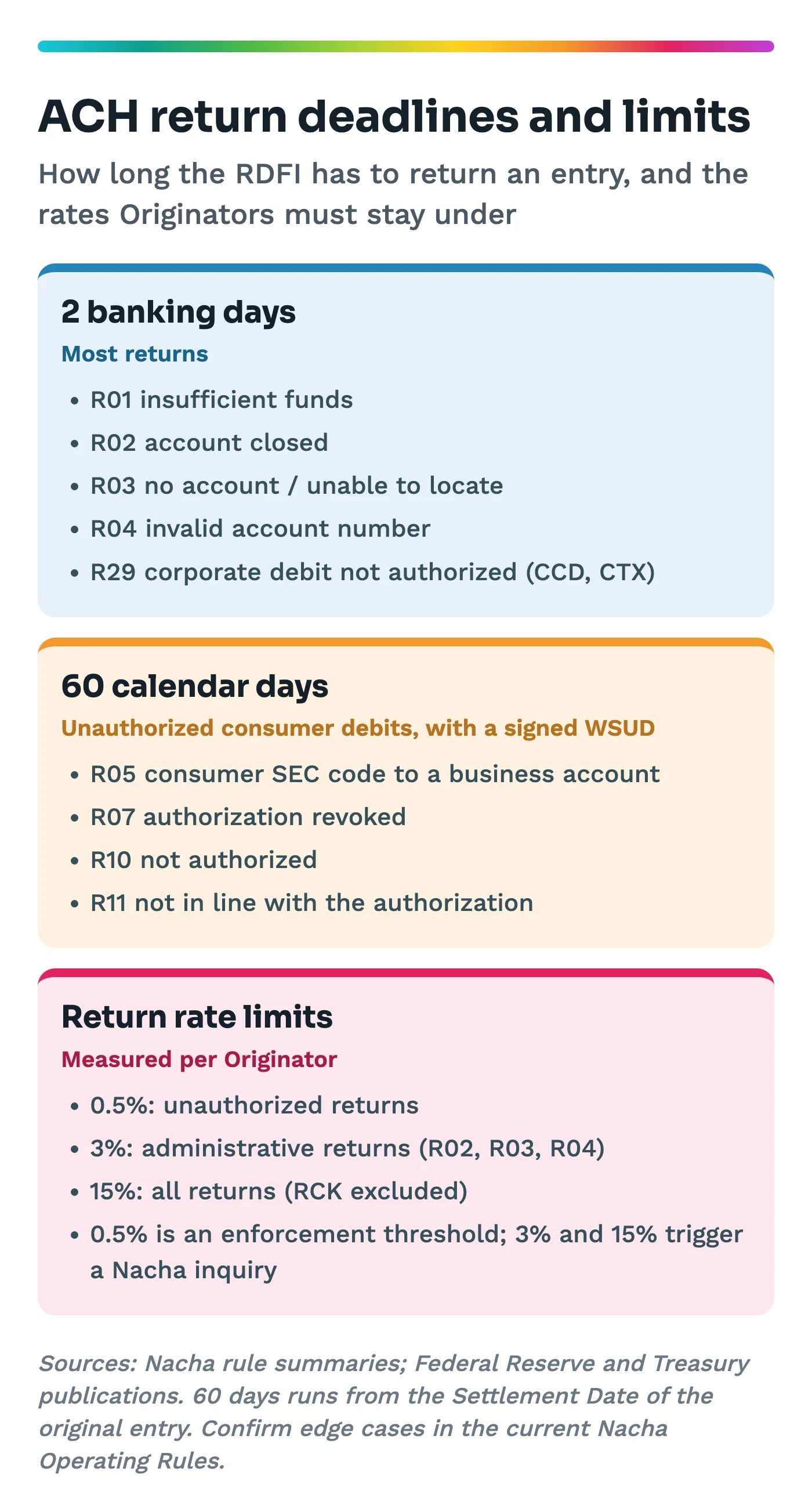
Unless the Rules give a different window, the return must be available to the ODFI by the opening of business on the second banking day after the Settlement Date. Example: a debit that settles on Wednesday, November 25, 2026 has banking day one on Friday, November 27 (Thanksgiving, November 26, is a federal holiday), so the return must be available by the opening of business on Monday, November 30. Banks set earlier internal cut-offs to meet this, so a business customer may have only until the next business day to report a problem.
| Code | Typical SEC codes | What the claim is | WSUD needed? |
|---|---|---|---|
| R05 | CCD, CTX sent to a consumer account | Consumer never authorized a corporate-coded debit | Yes |
| R07 | PPD, TEL, WEB (recurring debits) | Consumer revoked the authorization | Yes |
| R10 | Consumer SEC codes such as PPD, WEB, TEL, ARC, BOC, POP; IAT debits | Originator unknown or not authorized | Yes |
| R11 | Consumer SEC codes such as PPD, WEB, TEL, ARC, BOC, POP | Authorization exists but the entry did not follow its terms | Yes |
| R37 | ARC, BOC, POP | The check was also presented | Yes |
| R38 | ARC, BOC | Stop payment on the source check | No (stop payment) |
| R51, R53 | RCK | Ineligible or improper RCK, or item presented twice | Yes |
| R52 | RCK | Stop payment on the item | No (stop payment) |
The 60 days run from the Settlement Date of the original entry. A debit that settled on Thursday, October 1, 2026 reaches its 60th calendar day on Monday, November 30, so the return must reach the ODFI by the opening of business on Tuesday, December 1. Two changes effective October 1, 2024, per Nacha’s rule summary, also apply: a consumer may sign the WSUD as soon as the debit is presented (by posting or pending notice), and an RDFI that uses the extended window must return the debit by the opening of the sixth banking day after it finishes reviewing the signed WSUD.
R06 is a return the ODFI asks for. Since October 1, 2024 the ODFI may ask for any reason. The RDFI does not have to agree, but since April 1, 2025 it must tell the ODFI its decision or the status of the request within 10 banking days. R31 lets an RDFI return a CCD or CTX entry after the deadline when the ODFI agrees to accept it.
The two clocks are different. Nacha’s window runs from each entry’s Settlement Date and controls whether the RDFI can return the debit through the network. Under 12 CFR 1005.11, a consumer generally has 60 days after the bank sends the statement showing the error to report it. A consumer can be inside the Regulation E window but outside the Nacha one. Regulation E dispute timeframes then set the bank’s own investigation and provisional credit duties under the same section.
Since Nacha split the unauthorized codes (effective April 1, 2020), the choice of code depends on the account type and what went wrong:
R11 counts toward the unauthorized return rate and, since April 1, 2021, is covered by the Unauthorized Entry Fee. The live webinar Unauthorized Transactions – Reg E vs Nacha Operating Rules on December 18, 2026 lists R10 vs R11 among its topics.
Nacha measures each Originator’s debit returns over the preceding 60 days or two calendar months. The Federal Reserve’s FedPayments Reporter return ratio report (revised April 2026) groups the codes the same way.
| Measure | Codes counted | Level | What happens if exceeded |
|---|---|---|---|
| Unauthorized return rate | R05, R07, R10, R11, R29, R51 | 0.5% of debits | A threshold: the ODFI must act and Nacha can enforce |
| Administrative return rate | R02, R03, R04 | 3.0% of debits | A level that triggers a Nacha inquiry, not an automatic violation |
| Overall return rate | All return codes | 15.0% of debits (RCK excluded) | A level that triggers a Nacha inquiry, not an automatic violation |
The thresholds come from Nacha’s 2015 ACH Network Risk and Enforcement Topics rule, which cut the unauthorized threshold from 1.0% to 0.5%; R11 was added later.
For each return with R05, R07, R10, R11, R29 or R51, the ODFI pays a fee to the RDFI. Nacha receives no part of it. Nacha set it at $4.50 per return for returns settling on or after October 3, 2016, reviews it every three years and publishes the current amount in the Rules’ schedule of fees, so confirm today’s figure with your ODFI.
An ODFI may dishonor a return that is untimely, misrouted, a duplicate, has field errors, or is otherwise not permitted (for example an erroneous or reversing debit return, R62) within five banking days after the Settlement Date of the return. The RDFI may then contest the dishonor within two banking days after the Settlement Date of the dishonored return. Nacha describes these timeframes in its May 2026 request for information.
| Code | Meaning (paraphrased) | Sent by |
|---|---|---|
| R61 | Misrouted return | ODFI (dishonor) |
| R62 | Return of erroneous or reversing debit | ODFI (dishonor) |
| R67 | Duplicate return | ODFI (dishonor) |
| R68 | Untimely return | ODFI (dishonor) |
| R69 | Field error(s) | ODFI (dishonor) |
| R70 | Permissible return entry not accepted, or return not requested by ODFI | ODFI (dishonor) |
| R71 | Misrouted dishonored return | RDFI (contest) |
| R72 | Untimely dishonored return | RDFI (contest) |
| R73 | Timely original return | RDFI (contest) |
| R74 | Corrected return | RDFI (contest) |
| R75 | Return not a duplicate | RDFI (contest) |
| R76 | No errors found | RDFI (contest) |
| R77 | Non-acceptance of R62 dishonored return | RDFI (contest) |
For Originators, the practical code is R68: a late debit return can be dishonored, so ask your ODFI how fast it checks returns for timeliness.
Nacha’s list of rules effective in 2026 contains no change to a return code title or to the 2-day and 60-day windows. The changes that touch returns came earlier or are still ahead:
For most return codes, the return must be available to the ODFI by the opening of business on the second banking day after the Settlement Date of the original entry. Unauthorized consumer debits returned as R05, R07, R10 or R11 can be returned until the opening of business on the banking day after the 60th calendar day following the Settlement Date, with a signed Written Statement of Unauthorized Debit.
R03 means “No Account/Unable to Locate Account”: the account number has a valid structure but does not match an existing account or the name on the entry. It is returned within 2 banking days and counts toward the 3% administrative return rate. Contact the Receiver for the correct account number before sending a new entry.
Both say the debit was not authorized, but R10 is for consumer accounts and for consumer SEC codes (such as PPD or WEB) posted to business accounts, while R29 is for business accounts receiving CCD or CTX debits. R10 has a 60-day return window and needs a Written Statement of Unauthorized Debit; R29 must be returned within 2 banking days. Both count toward the 0.5% unauthorized return rate.
Yes. An entry returned as R01 or R09 may be reinitiated no more than two times after the original return, and bank guides add a limit of 180 days from the original Settlement Date. Each retry must carry “RETRY PYMT” in the Company Entry Description and keep the same Company Name, Company ID and Amount.
It is 0.5% of an Originator’s debit entries, counting returns coded R05, R07, R10, R11, R29 and R51 over the preceding 60 days or two calendar months. Nacha also sets a 3% level for administrative returns (R02, R03, R04) and a 15% level for all debit returns.
About 70 codes are in use, numbered R01 to R85 with gaps. They include RDFI return codes, ACH Operator codes, automated enrollment codes, dishonored and contested dishonored codes, and international (IAT) codes. Nacha has adopted R90 for sanctions-related returns, effective March 17, 2028.
Catch up on the 2026 Nacha rules
The live NEW Nacha Operating Rules for 2026 webinar on December 3 covers fraud monitoring Phases 1 and 2 for ODFIs, Originators, TPSPs, TPSs and RDFIs, plus the new PAYROLL and PURCHASE Company Entry Descriptions.
See the Nacha 2026 webinarThis article is general information, not legal or tax advice. Check the official sources above or consult a qualified advisor for your situation.